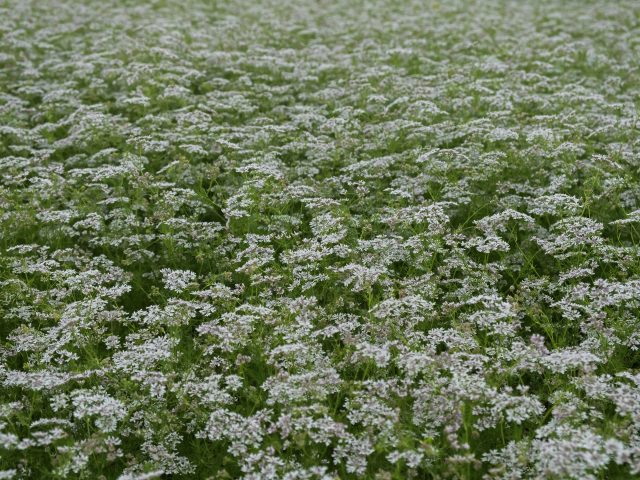

Dill is commonly associated with fresh herbs and seasoning, but for industry it is also an important essential-oil crop. Natural dill essential oil is used in aromatic and food ingredients, cosmetic and fragrance formulations, and other products where a distinctive spicy profile is required.
At the same time, the term “dill essential oil” does not always refer to exactly the same product. Its characteristics depend greatly on which part of the plant is used and how the raw material is processed.
From Seeds or from the Whole Plant?
Essential oil can be produced from mature dill fruits, often referred to commercially as seeds, as well as from the above-ground parts of the plant.
This distinction is important because different parts of dill contain different proportions of volatile compounds and therefore produce oils with different aromatic profiles.
For an industrial buyer, it is important to clarify not only that the product is “dill essential oil,” but also which part of the plant was used as the raw material.
This helps formulators understand whether a particular oil is suitable for the intended application.
How Dill Essential Oil Is Produced
One of the most common production methods is steam distillation.
Prepared plant material is placed in distillation equipment and exposed to steam. Volatile aromatic compounds are carried with the steam into the vapor phase.
The vapor is then cooled and condensed. The resulting liquid separates into a water phase and an essential oil phase.
Although the process appears relatively simple, the final quality of the oil depends on many parameters, including the condition and moisture content of the raw material, particle size, temperature, distillation time, and the point at which the process is stopped.
An excessively short distillation may reduce oil yield, while unsuitable processing conditions can affect the balance of volatile components.
Why Two Batches of Dill Oil May Differ
Even when essential oil is produced from the same botanical species, its characteristics may not be completely identical from batch to batch.
The composition can be influenced by:
- plant variety;
- growing region;
- seasonal weather conditions;
- stage of maturity;
- harvest timing;
- part of the plant used;
- storage conditions of the raw material;
- distillation parameters.
Russian researchers in 2025 compared essential oils obtained from dill fruits of different origins and also observed differences in both oil yield and chemical composition.
This is a good example of why B2B supply requires not only information about the plant species, but also quality control of each specific batch.
Where Dill Essential Oil Is Used
For industrial applications, dill essential oil is valued primarily as a natural aromatic ingredient.
It can be used in the development of:
- food flavor compositions;
- sauces and marinades;
- spicy and vegetable flavor profiles;
- meat and fish products;
- selected cosmetic and fragrance formulations;
- household products containing natural aromatic ingredients.
The appropriate dosage and permitted use always depend on the final application, formulation, and regulatory requirements of the target market.
What B2B Buyers Should Pay Attention To
For professional procurement, a pleasant aroma alone is not enough.
Buyers and formulators should consider the origin of the oil, the part of the plant used, and its main physicochemical characteristics. For more detailed evaluation, chromatographic analysis can be used to assess the volatile composition and compare different batches.
This is especially important for manufacturers that need to maintain a consistent aroma and performance from one production run to another.
From Field to Finished Oil
Dill essential oil is a good example of how the quality of a natural ingredient is formed throughout the entire production chain.
It begins with seeds and growing conditions, continues through harvesting and processing, and ends with proper storage and laboratory control of the finished batch.
For this reason, industrial essential oil is not simply “the smell of dill in concentrated form.” It is a natural ingredient whose characteristics depend on the entire production process.
Conclusion
Dill has long gone beyond its familiar role as a culinary herb. For the essential-oil industry, it is a valuable plant raw material capable of producing products with different aromatic and chemical profiles.
For B2B buyers, the key rule is simple: when selecting dill essential oil, it is important to know which part of the plant was used, how the oil was produced, and how the quality of the batch is verified.